Heat is the biggest killer of car batteries, and Brisbane has plenty of it. Long, humid summers, cars parked in full sun and hot engine bays all speed up the chemistry that wears a battery out. This guide explains what heat does to a battery, how to tell when yours is on the way out, and how to choose and look after a replacement so it lasts as long as possible in South East Queensland.
How can we help?
Need it fixed?
Find a local Car batteries in Brisbane heat auto electrician for anything from a flat battery to a full fit-out.
Find an auto electricianBuying parts?
Quality auto electrical parts from Ozautoelectrics, an established Australian supplier since 2010, dispatched through a nationwide network. For retail and trade buyers.
Shop partsDoing it yourself?
Free step-by-step guides written for Queensland conditions, with the parts you’ll need listed for each job.
Browse DIY guidesAuto electrician in Car batteries in Brisbane heat?
Are you an auto electrical business? List your business on this site.
List your business on this siteThe short version
- Heat shortens battery life. In Brisbane, many batteries are worn out well before the age they’d reach in a cooler climate.
- Summer damage often shows up as a no-start on the first cool morning in autumn, or after the car has sat for a few days.
- Get the battery tested before summer if it’s more than about three years old.
- Replace like with like: if your car came with an AGM or EFB battery, don’t downgrade to a standard one.
- Cars that sit for days, especially in apartment car parks, benefit from a smart maintenance charger.
What heat actually does to a battery
A standard car battery is lead plates in a sulphuric acid electrolyte. Heat speeds up every chemical reaction inside it, the useful ones and the destructive ones alike:
- Grid corrosion. The positive plate grids corrode faster when they’re hot. Corroded grids carry less current, and in the end they break.
- Water loss. In a conventional flooded battery, heat evaporates water from the electrolyte. If the plates are exposed, that part of the battery is permanently damaged.
- Self-discharge. A hot battery loses charge faster while the car is parked. A battery that sits partly discharged forms hard sulphate crystals on its plates (sulphation), which permanently cuts its capacity.
Under the bonnet on a hot Brisbane afternoon, the battery can sit well above the air temperature. Engine heat, a dark bonnet in the sun and heat soak after the engine is switched off all add to it.
Why batteries often fail in autumn, not summer
It’s common for a battery to “suddenly” fail in April or May. In most cases the damage was done in summer. Over the hot months the battery loses capacity, but warm weather makes cranking easy, so you don’t notice. Then the first cooler morning arrives: cold oil is thicker, the engine needs more current to turn over, and a weakened battery can’t deliver. The fix is to test before the hot season ends, not after the car won’t start.
Signs your battery is on the way out
- The engine cranks slowly, especially first thing in the morning or after the car has sat for a day or two.
- The battery warning light flickers, or the stop-start system stops working (many cars disable stop-start when the battery is weak).
- Electrical oddities when starting: the radio resets, the clock loses time, or warning lights flash on during cranking.
- White or blue-green powder around the terminals.
- The battery case is swollen or bulging. Replace it straight away, because that’s a sign of overheating or overcharging.
- It’s more than three to four years old and has never been tested.
Testing a battery
A quick resting voltage check with a multimeter, done when the car has been off for a few hours, gives a rough idea of the battery’s state of charge:
| Resting voltage | Approximate state of charge |
|---|---|
| 12.6 V or more | Fully charged |
| 12.4 V | About 75% |
| 12.2 V | About 50%, needs charging |
| 12.0 V or less | Flat, or the battery is failing |
Voltage alone doesn’t tell you how much the battery can deliver under load. A battery can show 12.6 V and still fail to start the car. An auto electrician or battery specialist will use a conductance tester or load tester, which measures cold cranking ability and gives a clear pass or fail. Many will also check the alternator’s charging output at the same time. A failing alternator kills new batteries.
Choosing the right replacement
Match the type
| Battery type | Where you’ll find it | Notes |
|---|---|---|
| Flooded (conventional) | Older and simpler cars | Cheapest. Some are serviceable, so check and top up the electrolyte with distilled water. |
| EFB (enhanced flooded) | Many cars with basic stop-start | Built for frequent restarts. Replace with EFB or AGM, not standard flooded. |
| AGM (absorbed glass mat) | Premium cars and advanced stop-start systems | Sealed, handles deep cycling and regenerative charging. Always replace with AGM. |
Fitting a cheaper flooded battery where an AGM or EFB belongs usually means a short life and stop-start faults. Some cars, especially many European models, also need the new battery registered with the car’s battery management system so it charges correctly. An auto electrician can do this with a scan tool.
Match the size and ratings
- Physical size and terminal layout. The battery must fit the tray and hold-down, with the terminals the right way round.
- Cold cranking amps (CCA). Meet or exceed the original rating.
- Reserve capacity (RC) or amp-hours (Ah). Higher is better if you run accessories with the engine off.
Heat-friendly choices
Some batteries are designed for hot climates. Look for a good warranty, a battery from a reputable brand and fresh stock. A battery that has sat on a warehouse shelf for a year has already lost some of its life.
Advertisement
Making a battery last in Brisbane
- Park in the shade when you can, or under cover. It helps the whole car, battery included.
- Drive it properly. Short trips never fully recharge the battery. Once a week, take a drive of 20 minutes or more at steady speed.
- Use a smart maintenance charger if the car sits for more than a week at a time. A good one charges in stages and then holds the battery at float. Leaving a cheap unregulated charger connected can overcharge it.
- Keep the terminals clean and tight. Clean off any corrosion with a baking soda and water solution, rinse, dry and coat with terminal grease. Loose clamps cause starting and charging faults.
- Check the hold-down. A loose battery vibrates, and vibration breaks internal connections.
- Have the charging system checked with the battery. Too much charging voltage cooks a battery, and too little leaves it permanently undercharged.
- Watch accessory drain. Dashcams in parking mode, fridges and aftermarket alarms can flatten a battery. Fit a low-voltage cut-off.
Old batteries are recycled
Lead-acid batteries are highly recyclable and shouldn’t go in household bins. Most battery retailers and auto electricians take old batteries, and many council transfer stations accept them too.
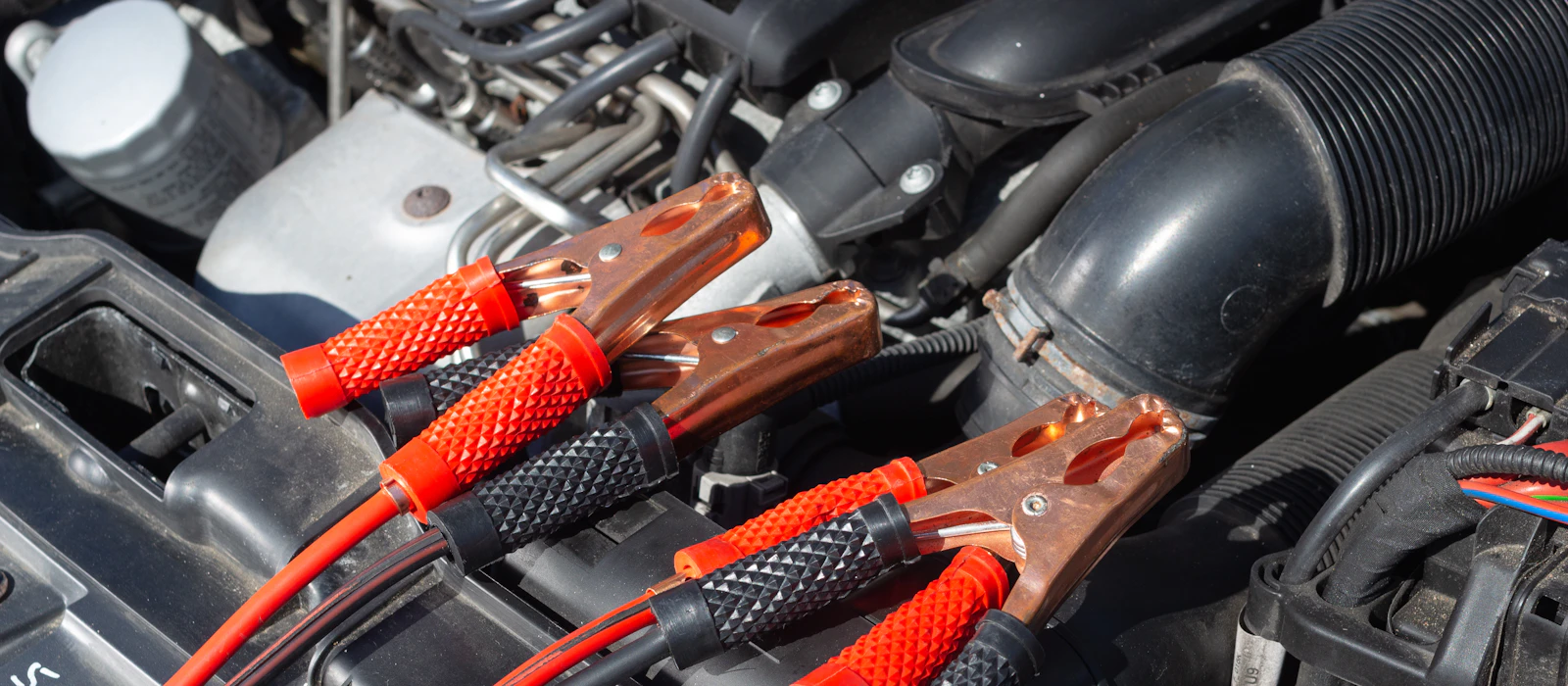
Jump-starting safely. Connect positive to positive, then the negative lead to a bare metal earth point on the dead car, away from the battery. Modern cars are sensitive to voltage spikes, so check the owner’s manual first. Some have dedicated jump points. If the battery is swollen, cracked or smells of rotten eggs, don’t jump it. Replace it.
Need a hand?
- Find a local auto electrician in the Brisbane directory, or by area: Northside, Southside, Wynnum Manly, Moreton Bay, Logan.
- Doing it yourself? Search for batteries, terminals, battery maintainers and isolators:
Search auto electrical parts
Searches the full range at Auto Electrical Australia, opening in a new tab. Popular: dual battery · LED light bars · trailer plugs · fuses
Run an auto electrical business in Car batteries in Brisbane heat?
- New to Ozautoelectrics? Apply for trade pricing on quality auto electrical parts.
- Already a trade customer? Log in and order parts at your trade price.
- Want more local customers? List your business on this site so drivers in Car batteries in Brisbane heat can find you.
Not confident doing this yourself?
There’s no shame in handing it over. A local auto electrician can diagnose the fault properly and get it done safely, especially for anything involving brakes, airbags, hybrid systems or air-con gas.
Find a local auto electrician Or shop the parts and do it yourself