South East Queensland might be the best launch pad in Australia for a weekend away. There’s Straddie by ferry from Cleveland, Moreton Island by barge from the Port of Brisbane, Bribie over the bridge, K’gari and Rainbow Beach up the coast, and the Sunshine Coast hinterland an hour north. Most of those trips involve a fridge, lights and a phone that needs charging, often for days without mains power. That’s what a dual battery system is for. This guide explains how one works, what to buy, and the mistakes to avoid in Brisbane’s climate.
How can we help?
Need it fixed?
Find a local Dual battery and caravan setups for SEQ trips auto electrician for anything from a flat battery to a full fit-out.
Find an auto electricianBuying parts?
Quality auto electrical parts from Ozautoelectrics, an established Australian supplier since 2010, dispatched through a nationwide network. For retail and trade buyers.
Shop partsDoing it yourself?
Free step-by-step guides written for Queensland conditions, with the parts you’ll need listed for each job.
Browse DIY guidesAuto electrician in Dual battery and caravan setups for SEQ trips?
Are you an auto electrical business? List your business on this site.
List your business on this siteThe key decisions
- Where the second battery goes: under the bonnet, in the tub or canopy, or in the caravan
- Battery type: AGM or lithium (LiFePO4)
- How it charges: a DC-DC charger for most modern vehicles
- Cable size and fusing: sized for the current and the length of the run
- Solar: whether you’ll add panels for longer stays
How a dual battery system works
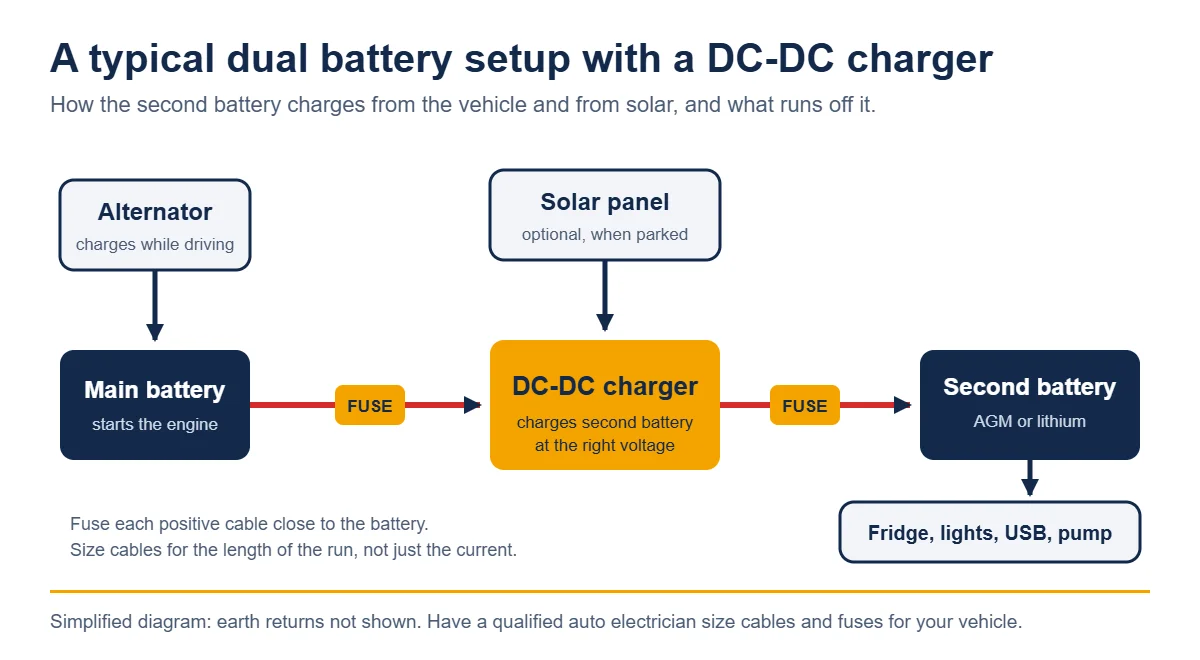
Your starting battery is built to deliver a big burst of current for a few seconds to start the engine. It isn’t built to be run flat by a fridge overnight. A dual battery system adds a second, deep-cycle battery that runs your accessories, and keeps it separate from the starting battery so you can always start the car.
While you’re driving, the alternator charges both batteries. When you stop, the two are isolated, so the fridge drains only the auxiliary battery.
DC-DC charger or isolator?
Older systems used a simple voltage-sensitive relay (VSR) or isolator. It connects the two batteries when the alternator is charging and separates them when it isn’t. That works with traditional alternators that hold a steady voltage of about 14 V or more.
Many modern vehicles have smart (variable voltage) alternators that drop their output to save fuel once the starting battery is charged. A VSR can’t charge an auxiliary battery properly from them. A DC-DC charger takes whatever the alternator supplies and converts it into a proper multi-stage charge for the second battery. It also lets you charge a different battery type, such as lithium, correctly. For most vehicles made in the last decade or so, a DC-DC charger is the right choice. Many also have a built-in solar regulator.
AGM or lithium?
| AGM | Lithium (LiFePO4) | |
|---|---|---|
| Usable capacity | About half the rated Ah for good life | Most of the rated Ah |
| Weight | Heavy | About half the weight for the same usable energy |
| Upfront cost | Lower | Higher |
| Heat tolerance | Handles under-bonnet heat better | Keep it out of the engine bay. Mount it in the cabin, canopy or van |
| Charging | Standard multi-stage profile | Needs a lithium-compatible charger and a built-in BMS |
Brisbane tip: under-bonnet temperatures in a Queensland summer are hard on any battery. If you go lithium, mount it somewhere cooler and make sure its battery management system (BMS) protects against high temperatures.
How big a battery do you need?
Start from your biggest load, which is almost always the fridge. A compressor fridge’s daily use depends on its size, how full it is, how often it’s opened and, most of all, how hot it is. Check its rated daily consumption and allow plenty extra for a hot Queensland weekend. Add lights, phone charging and anything else. Then size the battery so you only use what it can deliver comfortably. For AGM, that’s about half its rated capacity.
Advertisement
Cable and fusing: where most DIY systems go wrong
- Size the cable for the current and the length of the run. Long runs to a canopy or caravan need much heavier cable than you might expect. Undersized cable causes voltage drop, so the auxiliary battery never fully charges and the DC-DC charger may cut out.
- Fuse both ends. Every cable connected to a battery needs a fuse or circuit breaker close to the battery, at both the starting battery end and the auxiliary end. An unfused cable that chafes through can start a fire.
- Use proper lugs, crimped with the right tool, and seal them with adhesive heat-shrink.
- Protect the cable route. Use conduit, grommets through panels, and keep it clear of exhaust heat and moving parts.
- Use Anderson plugs for connecting a caravan, camper or portable battery box. They’re the Australian standard for this.
Caravans and campers
A caravan usually has its own battery, charged from the tow vehicle through the 12-pin plug or a separate Anderson plug. A small charging wire won’t do the job. Over the length of a car and caravan, a thin wire loses too much voltage. Most caravan setups use a heavy cable to an Anderson plug at the drawbar and a DC-DC charger in the van.
Caravans also need:
- An electric brake controller in the tow vehicle, and a breakaway system for heavier vans
- 12-pin plug wiring that matches the van
- Mains charging for powered sites, with a proper RCD-protected inlet installed by a licensed electrician
Solar for longer stays
For a few days in one spot, a solar panel or blanket keeps the auxiliary battery topped up. Use an MPPT regulator, either separate or built into your DC-DC charger. Keep the panel in full sun and the battery in the shade.
Before you head off
- Test the whole system with the fridge running, the day before you leave.
- Check every fuse holder, lug and Anderson plug for heat marks or looseness.
- Know where your fuses are and carry spares.
- On the beach at K’gari, Moreton or Bribie, keep the vehicle’s electrics as dry as you can, and rinse salt off when you get home.
When to use a professional. High-current wiring done badly can cause fires. If you’re not confident with cable sizing, fusing and crimping, have a local auto electrician install it. Many Brisbane 4WD outfitters do this every day. Find one in the directory or on the Moreton Bay and Wynnum Manly pages.
Parts for the job
Search for DC-DC chargers, isolators, deep-cycle batteries, battery cable, lugs, Anderson plugs, fuses and circuit breakers:
Search auto electrical parts
Searches the full range at Auto Electrical Australia, opening in a new tab. Popular: dual battery · LED light bars · trailer plugs · fuses
Run an auto electrical business in Dual battery and caravan setups for SEQ trips?
- New to Ozautoelectrics? Apply for trade pricing on quality auto electrical parts.
- Already a trade customer? Log in and order parts at your trade price.
- Want more local customers? List your business on this site so drivers in Dual battery and caravan setups for SEQ trips can find you.
Not confident doing this yourself?
There’s no shame in handing it over. A local auto electrician can diagnose the fault properly and get it done safely, especially for anything involving brakes, airbags, hybrid systems or air-con gas.
Find a local auto electrician Or shop the parts and do it yourself