
Last Updated: November 12, 2026
Quick Summary
Smart alternator failure shows up as a flickering or returning battery warning light, dim or flickering lights, a battery that keeps going flat, misbehaving electrics, starting problems or stalling, intermittent charging, and dashboard warnings beyond the battery light. Because a smart alternator deliberately varies its output, a single voltage reading proves very little. If you recognise two or more symptoms, have the charging system tested.
- A smart alternator is a computer-controlled charging unit that varies output based on load demand, battery condition and engine state.
- If a new battery goes flat within a fortnight, test the charging system rather than replacing the battery again.
- Testing a smart alternator takes a multimeter and ten minutes, but a single voltage reading proves very little.
- Choose a multimeter with DC voltage resolution to 0.01V and min/max capture to catch intermittent fluctuation.
- Voltage fluctuation from a failing battery sensor or module communication fault needs a scan tool, not a basic meter.
Table of Contents
- 7 Signs of Smart Alternator Failure
- How to Test Smart Alternator Voltage
- Best Multimeter for Car Electrical Testing
- Frequently Asked Questions
7 Signs of Smart Alternator Failure
A smart alternator failure rarely starts with a dead battery, it begins as a flickering headlight, an intermittent warning light, or a battery that keeps going flat overnight.
A smart alternator is a computer-controlled charging unit that varies output based on load demand, battery condition and engine state, rather than holding a fixed voltage, which makes failure hard to spot. Here are seven warning signs.
- Battery warning light that flickers or returns. An intermittent light points to a control or sensor fault.
- Dim or flickering lights. Voltage fluctuation shows up in lighting first.
- Battery keeps going flat. Repeated jump starts suggest the charging system is not replenishing the battery.
- Misbehaving electrics. Flickering gauges, radio dropouts and erratic power windows trace back to unstable supply voltage.
- Starting problems or stalling. Low voltage at cranking can stall a modern engine.
- Intermittent charging. Some days it charges, some days it does not, a classic smart-alternator symptom.
- Dashboard warnings beyond the battery light. Communication faults between the battery sensor, engine control module and charging control often surface as unrelated warnings.
Watch out: a battery that keeps going flat is often replaced when the alternator is the real fault. If a new battery goes flat within a fortnight, test the charging system.
If you recognise two or more symptoms, an auto electrician in Acacia Ridge can test 24V and heavy-vehicle charging systems, and an auto electrician in Archerfield handles batteries, starters and alternators for trucks, plant and fleet vehicles.
How to Test Smart Alternator Voltage
Testing a smart alternator takes a multimeter and ten minutes, but because a smart alternator deliberately changes its output, a single voltage reading proves very little.
Check battery voltage at the terminals with the engine off, then at idle, then bring the load up with headlights, air conditioning and the demister and watch whether voltage holds or sags. A low reading on a smart system is not automatically a fault, since many vehicles intentionally drop charging voltage to reduce engine load, which is why a charging test needs a scan tool to read the control module’s own view.
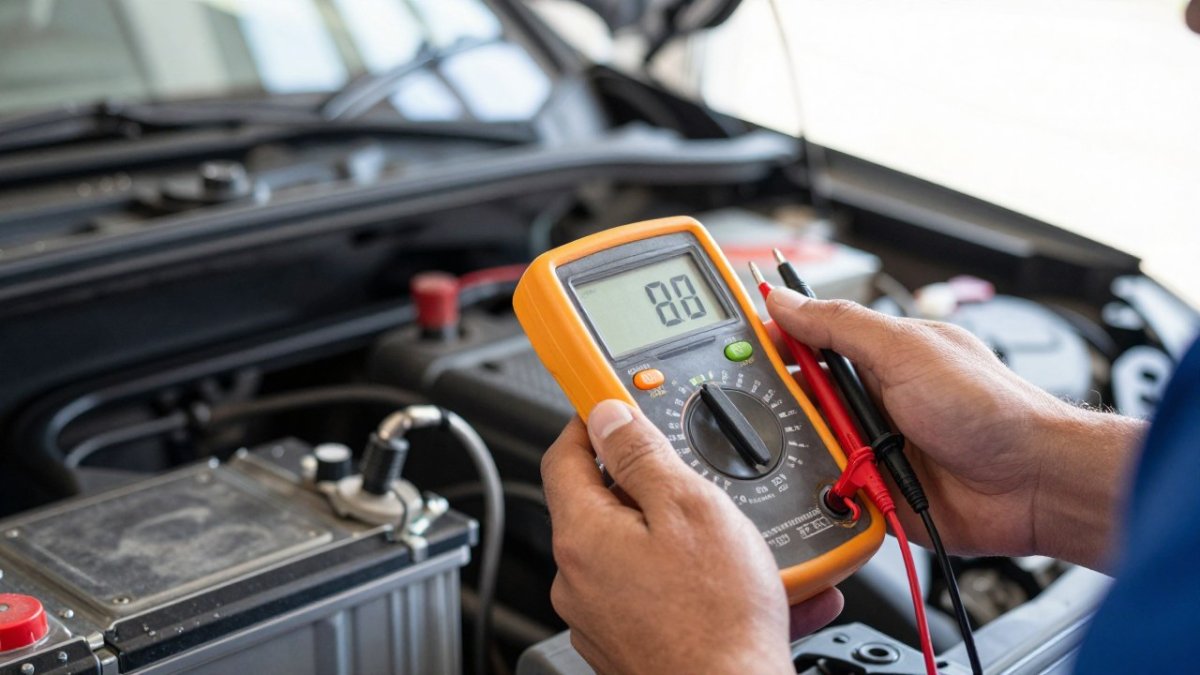
If results are ambiguous or the fault is intermittent, a specialist charging system check is faster than guessing. You can find an auto electrician by area across the region, or an auto electrician in Virginia for intermittent fault diagnosis.
Best Multimeter for Car Electrical Testing
A basic digital multimeter with DC voltage, resistance and continuity ranges covers most at-home charging checks, you need one that reads DC volts accurately to two decimal places.
- DC voltage resolution to 0.01V, so small charging differences are visible
- Min/max capture, which catches intermittent voltage fluctuation a live reading misses
- A clamp accessory or separate clamp meter for current draw testing on battery drain faults
- Auto-ranging, which saves time when moving between voltage and resistance checks
- A fused input and CAT rating appropriate to automotive work
Where a multimeter stops being enough is at the control layer: voltage fluctuation caused by a failing battery sensor or a communication fault between modules will not show on a basic meter. That is a scan-tool job.
For test gear, cable, fuses, connectors, relays and batteries, you can search the auto electrical parts range and use the buying guide before ordering.
| Symptom | Likely Area | First Check |
|---|---|---|
| Battery keeps going flat | Charging or battery drain | Charging voltage test |
| Dim or flickering headlights | Voltage fluctuation | Load-on voltage reading |
| Intermittent charging | Control module or sensor | Scan-tool fault codes |
| Flickering gauges | Unstable supply voltage | Earth and connector check |
A smart alternator fault that goes undiagnosed costs more than the repair: it takes batteries, starters and control modules with it. Auto Electrical Brisbane connects you with verified local and mobile auto electricians, area-specific guidance on how heat and salt air affect vehicle electrics, and a direct link to an extensive parts range. Search the directory to find a specialist near you, or claim your business listing if you are a qualified auto electrician serving the region.
Frequently Asked Questions
What are the common symptoms of a failing smart alternator?
Look for a battery warning light that flickers or stays on, dim or flickering headlights, interior lights that pulse, and a battery that keeps going flat despite being new. Gauges may jump, electrical accessories can behave erratically, and the engine may stall or crank slowly. Because a smart alternator varies its output by design, voltage that swings between roughly 12.2V and 14.8V can be normal, so persistent low readings and repeat flat batteries are the stronger clues that the unit itself is failing.
How do I test a smart alternator with a multimeter?
Set the meter to DC volts and measure across the battery terminals with the engine off, then again with the engine idling and electrical loads switched on. A healthy charging system should lift voltage above resting level, though a smart alternator may drop output when the battery is full. Watch for a low voltage reading that never recovers or swings wildly. If your readings look borderline, a workshop charging test with a scan tool will confirm whether the alternator, battery sensor or control module is at fault.
Should I use a DC-DC charger with a smart alternator?
For most dual-battery setups in 4WDs, caravans and utes, yes. A smart alternator deliberately lowers charging voltage once the start battery is topped up, which can leave an auxiliary battery undercharged through a simple isolator. A DC-DC charger takes the variable input and delivers a stable, correct charge profile for the auxiliary battery. If you run fridges, camp lighting or work equipment, have the installer confirm the charger suits your alternator’s behaviour and battery chemistry before fitting.
