Last Updated: November 11, 2026
Quick Summary
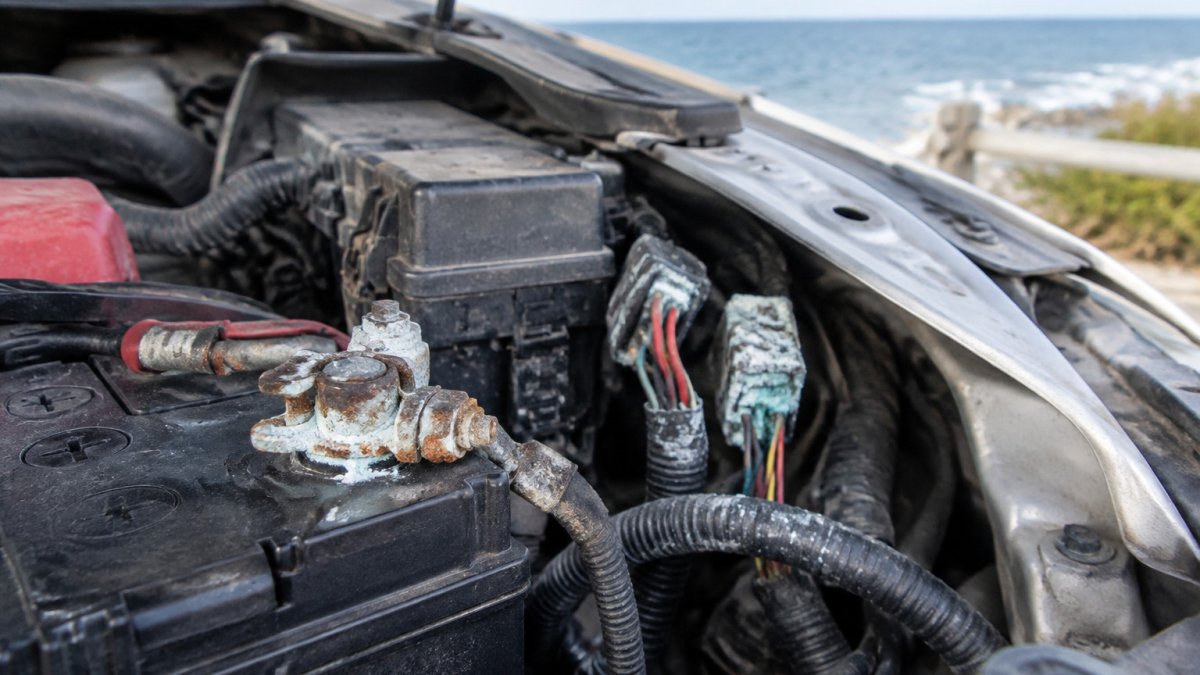
Signs of salt air corrosion on car electrics include green or white powder on battery terminals, loose or discoloured clamps, and slow cranking. Hidden corrosion often shows up as flickering dash lights, intermittent power windows, or warning lights that come and go. Salt air corrosion spreads along wiring, so early checks matter.
- Green, blue or white powder around battery posts is the most common visible sign.
- Clamps that are loose, hard to turn or discoloured point to corroded terminals.
- Slow cranking on cold mornings can mean corroded battery terminals creating resistance.
- Flickering dash lights or intermittent windows often signal a poor connection in the harness.
- Measure voltage drop under load: more than about 0.5 V across a connection indicates corrosion.
Table of Contents
- How Salt Air Corrodes Vehicle Electrical Systems
- Visible Signs of Salt Damage on Car Battery Terminals
- A DIY Diagnostic Check for Corroded Wiring and Undercarriage
- Choosing an Anti-Corrosion Spray for Car Wiring
- What Auto Electrical Corrosion Repairs Typically Involve
- Booking a Corrosion Check Before the Next Coastal Trip
- Frequently Asked Questions
How Salt Air Corrodes Vehicle Electrical Systems
Salt air corrosion is one of the fastest ways a car’s electrics can fail, especially for vehicles that spend time near the coast or on Brisbane’s southside.
Salt air corrosion is the slow breakdown of metal parts caused by airborne salt and moisture. If you want to see how a local auto electrician handles this in Brisbane’s industrial coastal area, auto electricians in Pinkenba lists the corrosion-related work they take on.
Corrosion does not stay in one place. Once it starts inside a connector, moisture gets trapped and the damage spreads along the wiring. This is why a small patch of corrosion can lead to a fault far from where it began.
Watch out: cleaning corroded terminals with water alone leaves residue that restarts the process. Dry the area fully and protect it afterwards.
Visible Signs of Salt Damage on Car Battery Terminals
Battery terminals are usually the first place salt damage shows. They sit in the open, they carry high current, and they are easy to overlook during servicing.
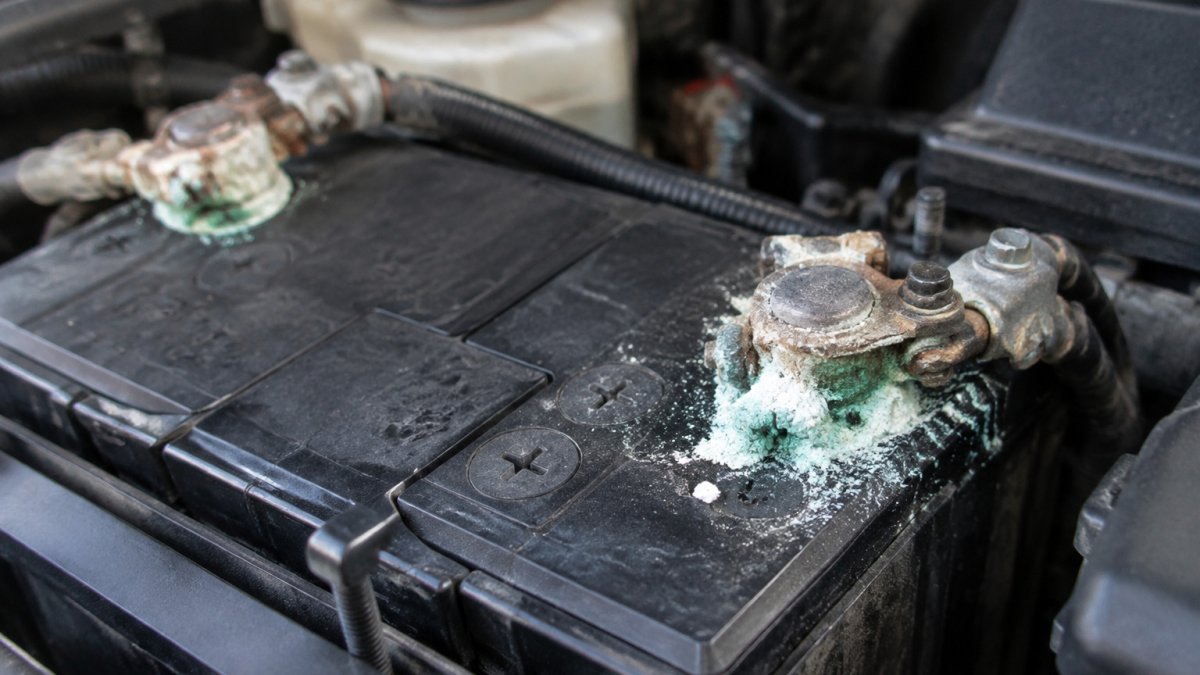
Look for these signs on the battery:
- Green, blue or white powder around the posts
- Crusty build-up that lifts the clamps
- Clamps that are loose, hard to turn or discoloured
- Slow cranking on cold mornings
Corroded terminals create resistance. That resistance makes the starter work harder and can leave you with a flat battery that seems fine after a jump start. A battery that drains faster than it should is worth checking for corrosion before replacing it.
Green and white powder on terminals
The green powder is usually copper sulphate or copper oxide, while the white crust is commonly a salt deposit. Both are poor conductors. Brush them off with a stiff nylon brush, then wipe the terminal clean. Replace the clamp if the metal is pitted, because a damaged clamp will keep losing contact.
Electrical glitches that point to hidden corrosion
Some corrosion never shows on the outside. Common warning signs include:
- Dash lights that flicker when you hit a bump
- Power windows or central locking that work only some of the time
- Interior lights or radio cutting out
- Warning lights that come on and then clear
These symptoms often point to a poor connection in the wiring harness or fuse box rather than a failed component. A diagnostic check will usually find the fault faster than replacing parts one by one.
A DIY Diagnostic Check for Corroded Wiring and Undercarriage
Most guides list the symptoms and stop there. This section gives you the actual inspection sequence, the safe isolation steps and the readings that tell you whether a connection is corroded or simply loose.
Isolate before you touch anything. Switch off the ignition, remove the key, and disconnect the negative battery terminal first, then the positive.
- Map the exposed connectors. Under the bonnet, check the fuse box lid seal, the main harness plugs near the strut towers, the alternator plug, the starter solenoid terminal and the ECU connectors. Look for green or white deposits, blackened pins, swollen insulation and any plug where the latch is cracked. A connector that has been wet long enough will show a tide mark of dried salt on the housing.
- Inspect the undercarriage runs. With the torch, follow the chassis rails, the fuel tank sender wiring, the rear wheel-arch loom and the trailer plug harness. Salt spray collects where the loom passes through a grommet or clips to the body. Look for split conduit, green powder inside the split, and clips that have rusted through.
- Test continuity correctly. Set the meter to continuity or the lowest ohms range. Probe the same circuit at both ends, not across the connector faces. A healthy run reads close to zero ohms. A reading that climbs while you wiggle the loom points to a broken strand or a corroded crimp rather than a clean break.
- Measure voltage drop under load. This is the step most DIY guides skip. Reconnect the battery, switch on the circuit (headlights, blower fan or starter crank) and measure DC volts between the battery positive post and the load side of the connector. More than about 0.5 V drop across a single connection is a sign of resistance from corrosion. Repeat on the earth side between the battery negative post and the component body; more than about 0.2 V is worth investigating.
- Check the earth points. Find the main earth strap between the engine block and the body, plus the earth points behind the kick panels and in the boot. Undo each bolt, look for white powder under the eyelet, clean to bare metal and refit with a star washer. A corroded earth can make every other test on the car read strangely.
- Inspect the trailer plug. If you tow, open the 7-pin or 12-pin plug and check for green pins and water inside the boot. Salt water enters through the cable gland and sits in the plug body.
Watch out: probing a live connector with the meter set to resistance can damage the meter and the module. Always confirm the meter setting before you touch a pin, and never bridge pins with the probe tips.
Record each reading and the connector location. A workshop can use that record to go straight to the fault.
The article’s diagnostic sequence gives these readings and steps to check for corrosion, in order.
| Check | Reading or action | Meaning |
|---|---|---|
| Connection voltage drop under load | More than about 0.5 V | Resistance from corrosion |
| Earth voltage drop under load | More than about 0.2 V | Earth point needs investigating |
| Continuity test | Close to zero ohms | Healthy circuit run |
| Continuity test | Reading climbs when loom is wiggled | Broken strand or corroded crimp |
| Isolation wait before unplugging airbag or ECU | At least ten minutes | Residual charge may remain |
| Trailer plug inspection | Green pins or water in boot | Salt water entering through gland |
Choosing an Anti-Corrosion Spray for Car Wiring
There are three product families that matter for electrical corrosion, and they are not interchangeable. Choosing the wrong one can either insulate a contact you need to conduct or trap moisture against the pin.
Dielectric grease is a non-conductive silicone or synthetic grease.
Anti-corrosion sprays are usually petroleum or lanolin-based and are designed to displace water and leave a soft film.
Conformal sealants and liquid electrical tape cure to a flexible film and are best for a repaired joint or a splice that has been soldered and heat-shrunk.
When comparing labels, check for these points:
- A stated dielectric strength and a temperature range that covers under-bonnet heat.
- Compatibility with plastic connector housings and rubber seals; some solvent-based sprays swell EPDM seals.
- Whether the product is safe on live circuits, because some sprays are flammable until the carrier evaporates.
- A clear instruction on cure time before the connector is re-mated.
Apply protection after cleaning, never before. Spraying over existing corrosion traps the salt under the film and keeps the reaction going.
Watch out: silicone grease that contains a conductive filler is sold for some applications, but it is not a substitute for a clean, tight terminal.
Compare the label against these points rather than the marketing name. Compare the label against these points rather than the marketing name, and clean the terminal before applying any product.
What Auto Electrical Corrosion Repairs Typically Involve
Repair work depends on how far the corrosion has spread. A workshop usually starts with a full inspection, then cleans or replaces the affected parts.
Common steps include:
- Cleaning or replacing battery terminals and clamps
- Repairing or replacing damaged wiring and connectors
- Cleaning earth points and re-securing them
- Testing circuits to confirm the fault is fixed
- Applying protective sealant to exposed connections
Costs vary with the vehicle, the number of faults and the parts needed. Pricing depends on the vehicle, the number of faults and the parts needed. For current pricing, contact Auto Electrical Brisbane through its website and ask for a quote based on your vehicle.
Repairs are not always a single visit. Intermittent faults can take longer to track down, so ask the technician how they plan to confirm the fix.
Booking a Corrosion Check Before the Next Coastal Trip
Check your electrics before a coastal or boating trip, when salt exposure is high. Address any corrosion before you travel, because a fault on the road is far more expensive to deal with.
If you have spotted corrosion or any of the warning signs above, an auto electrician can inspect it properly. To learn more about battery problems in the heat, see car batteries in Brisbane heat. If you tow a boat through salt water, boat trailer wiring for Moreton Bay boaties covers the wiring issues that matter most.
For a mobile check on Brisbane’s southside, book a corrosion check with AFG Car Diagnostics & Repairs to have the wiring inspected before your next trip.
BUTTON: Book Your Corrosion Check
CARD_TITLE: Is salt air hurting your car’s electrics?
CARD_TEXT: Auto Electrical Brisbane helps Brisbane drivers find local auto electricians for salt-related electrical faults.
Frequently Asked Questions
What are the early signs of electrical corrosion from salt air?
The earliest signs are usually small and easy to miss. Look for white or green powder on battery terminals, fuse box connectors and earth points. Lights that flicker or dim, and accessories that work intermittently, often point to corroded connector pins before any visible damage appears. A musty smell from wiring under the dash or a fuse that blows without an obvious cause are also worth investigating. Catching these early keeps a simple cleaning job from becoming a harness replacement.
Does salt air cause permanent damage to car wiring?
It can. Corrosion builds up inside connectors and on copper strands, raising resistance and eventually breaking the electrical path. Surface corrosion caught early can usually be cleaned and sealed, and the wire is often fine afterwards. Once strands are badly corroded or insulation has cracked, the affected section typically needs repairing or replacing. Dielectric grease and sealed connectors reduce the risk of that damage progressing.
How can I protect my car’s electrical system from coastal humidity?
Start by keeping battery terminals clean and coated with dielectric grease or a terminal protector. Wash the undercarriage with fresh water after drives near the coast, paying attention to the fuse box area and wiring looms. Park under cover where possible, and check that door and boot seals are intact so moist air does not build up inside the cabin. Inspect connectors every few months if you regularly drive near the water.
What components are most vulnerable to salt air corrosion?
Battery terminals, earth straps, fuse and relay connectors, alternator and starter connections, and exposed wiring near the chassis are the most vulnerable. Sensor connectors on the undercarriage and under the bonnet also corrode quickly, as do electrical ground points bolted to the body. These areas combine moisture, salt deposits and dissimilar metals, which speeds up the process considerably.
